8/16/2024

My stay in AWI, Bremen, Germany

Dear, everyone, this is Keito Aonuma.

Main Campus of AWI. My host lab was in a small container like the AMS building in AORI, but moved to the main building this Spring.

Port of Bremerhaven taken from AWI

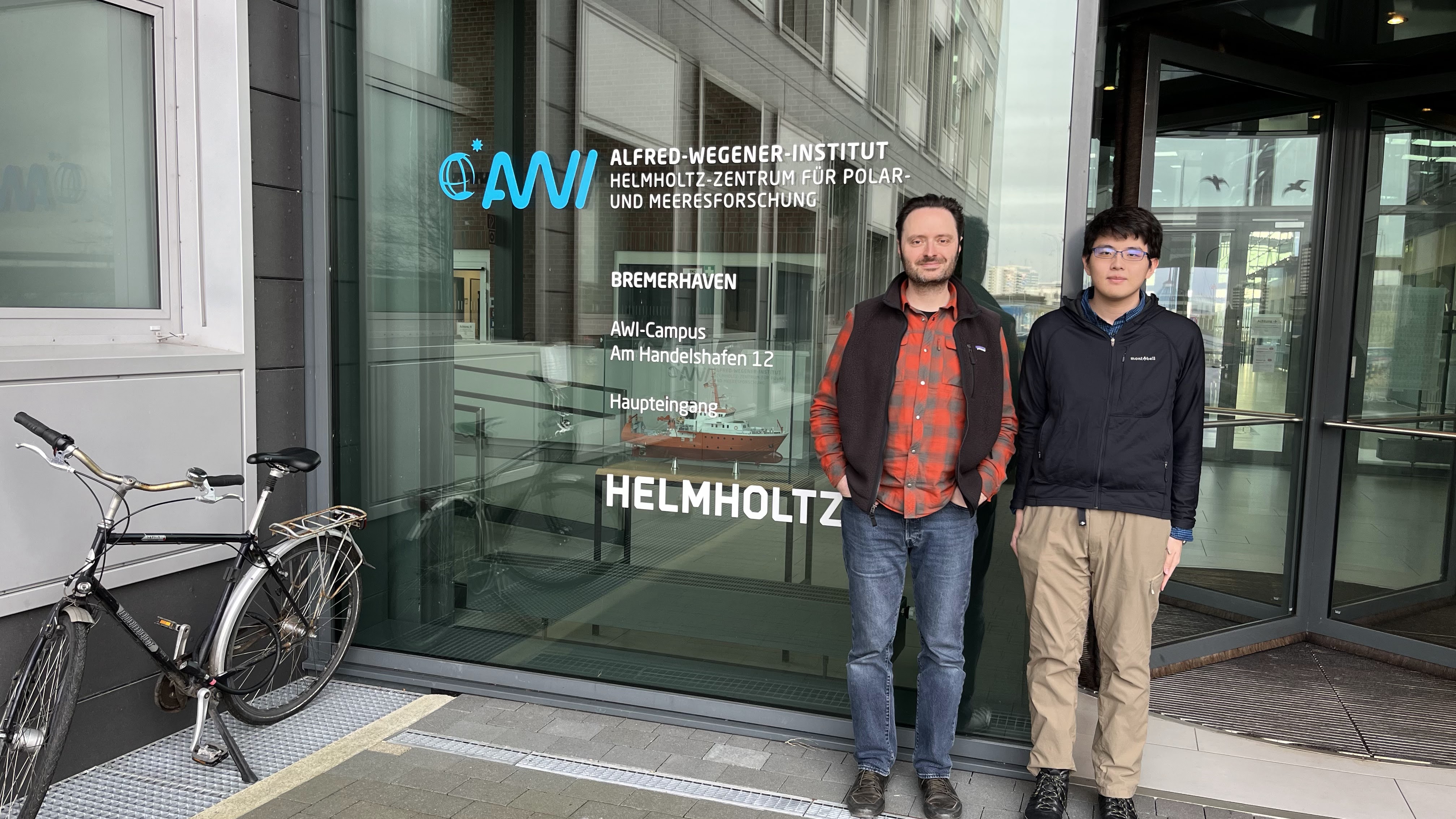
Picture with Prof.Jan Beermann, cited from IGPEES Report.

Last year, I spent three months (late October to mid-February) at the Alfred Wegener Institute for Polar and Marine Research (AWI) in Bremerhaven, Germany. AWI is a renowned institution known for its cutting-edge scientific research in polar regions and its comprehensive environmental studies in the North Sea.

During my first month, I focused on studying oceanography, ocean physics, and the ecosystem. The North Sea's characteristics differ significantly from the oceans surrounding Japan, providing me with a foundational understanding of its unique marine system. For example, the North Sea is a wide, shallow ocean, leading to extensive tidal synchronization. Additionally, I reviewed the characteristics of various biological phyla in detail for my internship work. The differences in ecosystem structures between the North Sea and Japanese waters result in the presence of different species. Although I must refrain from mentioning specific prevalent species due to ongoing research, this month allowed me to gain a deep understanding of the organisms inhabiting the North Sea.

This preparatory period was necessary not only for studying but also, unfortunately, for managing procedures related to residential permits in Germany.

In late November, my experiment began. I joined a research team analyzing the benthic ecosystem of the German Bight, a region of the North Sea. My main task was to extract organisms (unfortunately deceased due to formalin) from sediment samples. Throughout the experiment, I classified these organisms, which deepened my understanding of the North Sea ecosystem. Although examining samples under a stereo microscope was quite tiring, it provided me with valuable experience. This experience strongly motivated me to further my research on benthic organisms and other marine systems.

A better understanding of ecosystems, especially benthic ecosystems, is crucial for comprehending the carbon cycle in which these ecosystems are involved. Benthic organisms, closely associated with sediments, play a key role in the material cycle between soil and water.

I would like to thank Dr. Yokoyama, my host Dr. Jan Beermann, and all the people who helped me during my stay abroad.

 
Bremerhaven's Christmas Market ~~!!!!!

Christmas Market of Bremen. The Old City Hall is registered as a World Heritage.

------------

I was abroad from August last year until the latter half of April this year, receiving various forms of support during my stay. Below are links to reports detailing my experiences in the different locations I visited:

1. UNIS, Longyearbyen, Svalbard, Norway (Aug.2023 - Sep.2023)
→ https://jmsfmml.or.jp/j/activity/hidaka/report_r05_aonuma.pdf [jp]
→https://lams-yokoyama.blogspot.com/2024/08/my-stay-in-unis-university-centre-in.html

2. 7th International Otolith Symposium, Chile (Oct. 2023) 
→ https://lams-yokoyama.blogspot.com/2023/12/blog-post.html 

3. PUCV, Chile (Oct. 2023)
4. AWI, Germany (Oct./Nov. 2023 - Feb.2024)
5. UNIS, Longyearbyen, Svalbard, Norway (Feb.2024 - Mar.2024)
→ https://www.s.u-tokyo.ac.jp/ja/IGPEES/files/report/2023/aonuma.pdf [jp/en]
→https://lams-yokoyama.blogspot.com/2024/08/my-stay-in-awi.html (for AWI)
→https://lams-yokoyama.blogspot.com/2024/08/my-stay-in-unis-university-centre-in.html (for Winter UNIS)

6. EGU General Assembly 2024, Wien, Austria (Apr.2024)
→https://lams-yokoyama.blogspot.com/2024/08/egu2024-short-report.html

These lists are also working for this article's reference ~ Thank you ~

------------

8/14/2024

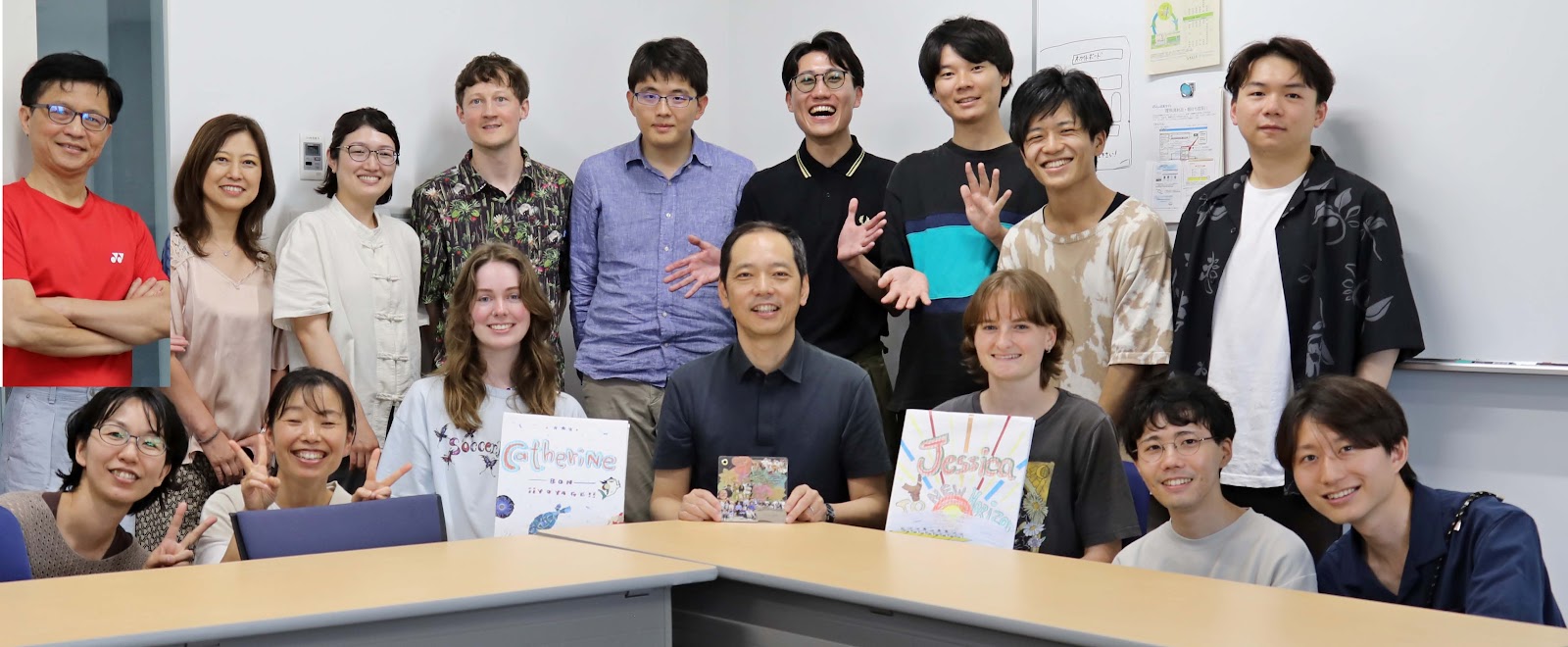
Farewell and Graduation Party for Jessica and Catherine

In June, our lab had the bittersweet pleasure of celebrating the achievements and farewells of Jessica and Catherine, two honors students from the Australian National University. 


Jess and Cat, thank you for your hard work, dedication, and the energy you've brought to our lab. You’ve left an indelible mark on our hearts and our research, and we wish you all the success in your future endeavors. 


As we raise a toast to your graduation, know that you will always have a place in our lab, and we look forward to hearing about your future accomplishments. Congratulations and farewell <3


8/06/2024

New Papers (AGU, EGU) July 29–August 4, 2024

 Geophysical Research Letters

  1. Improved Simulation of Antarctic Sea Ice by Parameterized Thickness of New Ice in a Coupled Climate Model
    Yongjie Fang,  Junchen Yao,  Tongwen Wu,  Fanghua Wu,  Jianglong Li

  2. Impact of Warming Trend in Western Equatorial Pacific on Modulating the Triple-Dip La Niña and Its Associated Teleconnection in 2020–2022
    Pei-ken Kao,  An-Yi Huang,  Chi-Cherng Hong,  Jun Chiang,  Chih-Chun Chang

  3. Evidence of Ecosystem Tipping Point on St. Lawrence Island: Widespread Lake Drainage Events After 2018
    Aobo Liu,  Xiao Cheng,  Chengxin Wang,  Yating Chen

  4. Revisiting Elevated δ13C Values of Sediment on Modern Carbonate Platforms
    Elizabeth J. Trower,  Brianna M. Hibner,  Tyler A. Lincoln,  Jacqueline E. Dodd,  Cedric J. Hagen,  Marjorie D. Cantine,  Maya L. Gomes

  5. Bristlecone Pine Maximum Latewood Density as a Superior Proxy for Millennium-Length Temperature Reconstructions
    T. De Mil,  V. Matskovsky,  M. Salzer,  L. Corluy,  L. Verschuren,  C. Pearson,  L. Van Hoorebeke,  V. Trouet,  J. Van den Bulcke

  6. Distinct Changes in the Influence of North Tropical Atlantic SST on ENSO Under Greenhouse Warming: A Comparison of CMIP5 and CMIP6
    Ji-Gwang Kim,  Hyun-Su Jo,  Yoo-Geun Ham,  Jae-Heung Park

  7. Precipitation Control on Weathering Intensity and Depositional Flux of Meteoric 10Be Revealed From Soil Profiles Along a Climate Gradient (Chile)
    Laura V. Krone,  Hella Wittmann,  Friedhelm von Blanckenburg


    Geochemistry, Geophysics, Geosystems

  8. Sediment Provenance Along the Middle Miocene‐Pleistocene Nankai Subduction Zone From Sediment Transport to Accretion: Implications for Stratigraphy in the Accretionary Prism
    P. H. Cornard,  H. L. Dawson,  K. T. Pickering


    Paleoceanography and Paleoclimatology

  9. Reconstructing the Tropical Thermocline From Oxygen‐Isotopes in Planktonic and Benthic Foraminifera
    K. Q. Lakhani,  J. Lynch-Stieglitz,  B. Findley 

  10. Climatic and Environmental Impacts on the Sedimentation of the SW Taiwan Margin Since the Last Deglaciation: Geochemical and Mineralogical Investigations
    Joffrey Bertaz,  Zhifei Liu,  Christophe Colin,  Arnaud Dapoigny,  Andrew Tien-Shun Lin,  Yanli Li,  Zhimin Jian


    Journal of Geophysical Research: Oceans

  11. Extreme Storm Surge Events and Associated Dynamics in the North Atlantic
    Simon Barbot,  Lucia Pineau-Guillou,  Jean-Marc Delouis 

  12. Digitizing the Williamstown, Australia Tide‐Gauge Record Back to 1872: Insights Into Changing Extremes
    Kathleen L. McInnes,  Julian G. O’Grady,  Ben S. Hague,  Rebecca Gregory,  Ron Hoeke,  Claire Trenham,  Alec Stephenson

  13. Three Forcing Mechanisms of Freshwater Transport in Fram Strait
    T. Karpouzoglou,  L. De Steur,  L. H. Smedsrud,  M. Karcher,  H. Sumata


    Climate of the Past

  14. Interaction between the East Asian summer monsoon and westerlies as shown by tree-ring records
    Shengchun Xiao, Xiaomei Peng, Quanyan Tian, Aijun Ding, Jiali Xie, and Jingrong Su

  15. Advances in conceptual modelling of the variable nature of Dansgaard-Oeschger events
    Jonathan Ortved Melcher, Sune Halkjær, Peter Ditlevsen, Peter L. Langen, Guido Vettoretti, and Sune Olander Rasmusse

  16. Patterns of centennial to millennial Holocene climate variation in the North American mid-latitudes
    Bryan N. Shuman


8/03/2024

New Papers (Nature, Science, etc.) July 30-August 3, 2024

 Nature


1.     Deeper and stronger North Atlantic Gyre during the Last Glacial Maximum

Jack H. Wharton, Martin Renoult, Geoffrey Gebbie, Lloyd D. Keigwin, Thomas M. Marchitto, Mark A. Maslin, Delia W. Oppo & David J. R. Thornalley


Science


2.     Mid-Pleistocene climate transition triggered by Antarctic Ice Sheet growth

Zhisheng An, Weijian Zhou, Zeke Zhang, Xu Zhang, Zhonghui Liu, Youbin Sun, Steven C. Clemens, Lixin Wu, Jiaju Zhao, Zhengguo Shi, Xiaolin Ma, Hong Yan, Gaojun Li, Yanjun Cai, Jimin Yu, Yuchen Sun, Siqi Li, Yu’ao Zhang, Christian Stepanek, Gerrit Lohmann, Guocheng Dong, Hai Cheng, Yu Liu, Zhangdong Jin, Tao Li, Yifei Hao, Jing Lei, Wenju Cai


3.     Recent tropical Andean glacier retreat is unprecedented in the Holocene

Andrew L. Gorin, Jeremy D. Shakun, Andrew G. Jones, Tori M. Kennedy, Shaun A. Marcott, Brent M. Goehring, Lucas K. Zoet, Vincent Jomelli, Gordon R. M. Bromley, Emilio I. Mateo, Bryan G. Mark, Donald T. Rodbell, Adrien Gilbert, Marc W. Caffee


Geology


4.     Volcanic and orbitally forced carbon release during the Middle Eocene Climatic Optimum

Yiquan Ma; Majie Fan; Chen Zhang; Stephen E. Grasby; Runsheng Yin; Yangbo Lu; Bolin Zhang; Xin Jin; Chao Ma; Yongchao Lu; Appy Sluijs


Nature Communications


5.     Holocene thinning in central Greenland controlled by the Northeast Greenland Ice Stream

Ilaria Tabone, Alexander Robinson, Marisa Montoya, & Jorge Alvarez-Solas


6.     The 4.2 ka event is not remarkable in the context of Holocene climate variability

Nicholas P. McKay, Darrell S. Kaufman, Stéphanie H. Arcusa, Hannah R. Kolus, David C. Edge, Michael P. Erb, Chris L. Hancock, Cody C. Routson, Maurycy Żarczyński, Leah P. Marshall, Georgia K. Roberts & Frank Telles


Nature Climate Change

7.     Vulnerability of mineral-associated soil organic carbon to climate across global drylands

Paloma Díaz-Martínez, Fernando T. Maestre, Eduardo Moreno-Jiménez, Manuel Delgado-Baquerizo, David J. Eldridge, Hugo Saiz, Nicolas Gross, Yoann Le Bagousse-Pinguet, Beatriz Gozalo, Victoria Ochoa, Emilio Guirado, Miguel García-Gómez, Enrique Valencia, Sergio Asensio, Miguel Berdugo, Jaime Martínez-Valderrama, Betty J. Mendoza, Juan C. García-Gil, Claudio Zaccone, Marco Panettieri, Pablo García-Palacios, Wei Fan, Iria Benavente-Ferraces, Ana Rey, Nico Eisenhauer, Simone Cesarz, Mehdi Abedi, Rodrigo J. Ahumada, Julio M. Alcántara, Fateh Amghar, Valeria Aramayo, Antonio I. Arroyo, Khadijeh Bahalkeh, Farah Ben Salem, Niels Blaum, Bazartseren Boldgiv, Matthew A. Bowker, Donaldo Bran, Cristina Branquinho, Chongfeng Bu, Yonatan Cáceres, Rafaella Canessa, Andrea P. Castillo-Monroy, Ignacio Castro, Patricio Castro-Quezada, Roukaya Chibani, Abel A. Conceição, Courtney M. Currier, Anthony Darrouzet-Nardi, Balázs Deák, Christopher R. Dickman, David A. Donoso, Andrew J. Dougill, Jorge Durán, Hamid Ejtehadi, Carlos Espinosa, Alex Fajardo, Mohammad Farzam, Daniela Ferrante, Lauchlan H. Fraser, Juan J. Gaitán, Elizabeth Gusman Montalván, Rosa M. Hernández-Hernández, Andreas von Hessberg, Norbert Hölzel, Elisabeth Huber-Sannwald, Frederic M. Hughes, Oswaldo Jadán-Maza, Katja Geissler, Anke Jentsch, Mengchen Ju, Kudzai F. Kaseke, Liana Kindermann, Jessica E. Koopman, Peter C. Le Roux, Pierre Liancourt, Anja Linstädter, Jushan Liu, Michelle A. Louw, Gillian Maggs-Kölling, Thulani P. Makhalanyane, Oumarou Malam Issa, Eugene Marais, Pierre Margerie, Antonio J. Mazaneda, Mitchel P. McClaran, João Vitor S. Messeder, Juan P. Mora, Gerardo Moreno, Seth M. Munson, Alice Nunes, Gabriel Oliva, Gastón R. Oñatibia, Brooke Osborne, Guadalupe Peter, Yolanda Pueyo, R. Emiliano Quiroga, Sasha C. Reed, Victor M. Reyes, Alexandra Rodríguez, Jan C. Ruppert, Osvaldo Sala, Ayman Salah, Julius Sebei, Michael Sloan, Shijirbaatar Solongo, Ilan Stavi, Colton R. A. Stephens, Alberto L. Teixido, Andrew D. Thomas, Heather L. Throop, Katja Tielbörger, Samantha Travers, James Val, Orsolya Valko, Liesbeth van den Brink, Frederike Velbert, Wanyoike Wamiti, Deli Wang, Lixin Wang, Glenda M. Wardle, Laura Yahdjian, Eli Zaady, Juan M. Zeberio, Yuanming Zhang, Xiaobing Zhou & César Plaza


Science Advances


8.     Uncertainties too large to predict tipping times of major Earth system components from historical data

Maya Ben-Yami, Andreas Morr, Sebastian Bathiany, Niklas Boers


9.     Enhanced Atlantic Meridional Mode predictability in a high-resolution prediction system

Qiuying Zhang, Ping Chan, Dan Fu, Stephen G. Yeager, Gokhan Danabasoglu, Frederic Castruccio, and Nan Rosenbloom

7/23/2024

New Papers (AGU, EGU etc.) 2024/6/26-2024/7/2

Climate of the Past

1. Pfister, C., Brönnimann, S., Altwegg, A., Brázdil, R., Litzenburger, L., Lorusso, D., & Pliemon, T. (2024). 600 years of wine must quality and April to August temperatures in western Europe 1420–2019. Climate of the Past, 20(6), 1387-1399.

2. Duan, P., Li, H., Ma, Z., Zhao, J., Dong, X., Sinha, A., ... & Cheng, H. (2024). A series of climate oscillations around 8.2 ka revealed through multi-proxy speleothem records from North China. Climate of the Past, 20(6), 1401-1414.

3. Muschitiello, F., & Aquino-Lopez, M. A. (2024). Continuous synchronization of the Greenland ice-core and U–Th timescales using probabilistic inversion. Climate of the Past, 20(6), 1415-1435.

Geochemistry, Geophysics, Geosystems

4. Beaudry, P., & Sverjensky, D. A. (2024). Oxidized sulfur species in slab fluids as a source of enriched sulfur isotope signatures in arcs. Geochemistry, Geophysics, Geosystems, 25(7), e2024GC011542.

5. Fontenot, K., DeLong, K. L., Schubert, B. A., Warny, S., Wallace, D. J., Miller, C. M., ... & Caporaso, A. (2024). Snapshots of coastal ecology using multiproxy analysis reveals insights into the preservation of swamp and marsh environments since the late Pleistocene. Geochemistry, Geophysics, Geosystems, 25(7), e2024GC011489.