2/04/2025

New Papers (Elsevier, etc) 2025/1/28-2025/2/3

Chemical Geology

[1] Constraining sulfate sources and its implications on atmospheric pCO2 in Arid Regions: Evidence from the Tarim Basin. 

Jia, G. D., Zhong, J., Li, S. L., Xu, S., Luo, H., & Liu, C. Q.

[2] Seawater temperatures during the early to middle Ediacaran: Phosphate oxygen isotope records

Fan, H., Chen, Z., Zhang, F., Zhu, C., Du, S., Zhang, Y., ... & Algeo, T. J.

[3] Triple oxygen isotopic fractionation in CO2-CaCO3-H2O system during CO2-H2O exchange, carbonate precipitation, and acid digestion

Roy, P., Laskar, A. H., Ghoshmaulik, S., Bhattacharya, S. K., Rangarajan, R., & Liang, M. C. 

[4] Comparisons of pretreatment extraction methods for tree-ring radiocarbon analysis

Qin, J., Niu, Z., Zhou, W., Huang, Y., Feng, X., Liang, D., ... & Wang, H. 

[5] Predominant biogenic contribution of dissolved inorganic carbon in karst rivers, Southwest China

Zheng, Y., Ding, H., Zhong, J., Lang, Y., Li, S. L., Xu, S., & Liu, C. Q.


Earth and Planetary Science Letters

[6] Decreased marine organic carbon burial during the Hirnantian glaciation

Yang, S., & Fan, J.

[7] Phosphorus-to-calcium ratios in benthic foraminiferal shells as a proxy for coastal seawater phosphate concentrations

Zhang, H., Xu, B., Lai, Z., Paytan, A., Burnett, W. C., Guo, X., ... & Yu, Z.

[8] Earthquake-triggered submarine canyon flushing transfers young terrestrial and marine organic carbon into the deep sea

Maier, K. L., Ginnane, C. E., Naeher, S., Turnbull, J. C., Nodder, S. D., Howarth, J., ... & Hillman, J. I.


Geochimica et Cosmochimica Acta

N/A


Global and Planetary Change

[9] Using seasonal palaeo-flow reconstructions and artificial neural networks for daily water balance modelling: A case study from Tasmania, Australia

Verdon-Kidd, D. C., Allen, K. J., Kidd, L. J., Maxwell, C., Willis, M., & Baker, P.

[10] Coral-derived seasonal seawater δ18O records from the Northern South China Sea: Hydroclimatic insights into the Medieval Climate Anomaly and Little Ice Age

Guo, H., Chen, X., Guo, Y., Zhao, J. X., Wei, G., & Deng, W.

[11] Sea surface water isotope changes recorded by alkenone δ2H from the northern South China Sea over the last 260 kyrs

He, J., Sessions, A. L., Li, L., & Jia, G.

[12] Obtaining refined Euro-Mediterranean rainfall projections through regional assessment of CMIP6 General Circulation Models

Ferreiro-Lera, G. B., Penas, Á., & del Río, S. 

[13] Impact of upstream westerly jet stream on tropospheric dust over the Tibetan Plateau in boreal spring

Feng, X., Mao, R., Gong, D. Y., Shi, C., & Wu, G.


Marine Geology

[14] Development shifts on the emerging Järve coast (Estonia) in Late Holocene

Luik, K., Tõnisson, H., Rivis, R., Vilumaa, K., Vaasma, T., Vandel, E., ... & Suursaar, Ü. 

[15] Influence of the density stratification on the vertical distribution of suspended sediment in a partially mixed estuary

Wang, Y., Jiang, C., Cheng, H., Cai, H., Li, W., & Teng, L.

[16] Major Holocene glacio-isostatically-induced earthquakes triggered mass-transport deposits and seabed displacements in Lake Melville

Syvitski, J., Normandeau, A., & Lajeunesse, P.

[17] High-precision estimation of a paleo-tsunami inundation area by identifying tsunami traces beyond sandy tsunami deposits: A case study of the 869 CE Jogan tsunami in Fukushima, northeastern Japan

Komeiji, K., Shinozaki, T., Sugawara, D., Ishizawa, T., Ikehara, M., & Fujino, S.


Palaeogeography, Paleoclimatology, Paleoecology

[18] Snapshots of mid-to-late Holocene sea-surface temperature variability from a subtropical western Atlantic coral reef

Jacobs, J. A., Richey, J. N., Flannery, J. A., Thirumalai, K., & Toth, L. T. 


Quaternary Geochronology

N/A


Quaternary International

[19] Late Quaternary palaeoenvironmental and palaeogeographic evolution in the Fuego river valley, central Tierra del Fuego, southern South America

Alli, P., Montes, A., Candel, S., Borromei, A. M., Rodríguez, S., Coronato, A., & López, R. 


Quaternary Research

[20] Pedogenic carbonate as a transient soil component in a humid, temperate forest (Michigan, USA)

Kelson, J. R., Huth, T. E., Andrews, K., Bartleson, M. N., Cerling, T. E., Jin, L., ... & Levin, N. E. 


2/01/2025

Better Late Than Never: A Throwback to the R/V Mirai MR24-02 Research Cruise (March 2024)

哈咯~ D1のMiyaです!It’s February 2025, and I’m finally writing about a cruise that happened in March 2024. Why now? Because I’m heading on another one next week and, and instead of packing, I’m reminiscing. Call it procrastination or call it "mentally getting into the ocean zone"—either way, here we are.

The Struggle is Real (But Temporary)

Last March, I boarded JAMSTEC’s R/V Mirai (未来, "future" in Japanese) for my second-ever research cruise. We set off from Mutsu, Aomori, drilled 6-meter piston cores from the Chishima Trench (~6000m deep) near the Kuril Strait, and ended in Shimizu Port, Shizuoka, next to the legendary Chikyu (地球, “Earth”)—IODP’s deep-sea drilling vessel.

The first five days? Rough. Literally. I had just said my last goodbye to my grandmother in Beijing, was running hourly water sampling solo, and was severely sleep-deprived while trying to instruct others on something I was still figuring out myself. Large waves, constant motion, and self-doubt hit all at once. But as the days passed, I found my rhythm.

Finding Joy in the Deep

The moment I started getting along with everyone, and leaning on my shipmates for support, things shifted. I wasn’t just surviving—I was enjoying it. The student-led workout sessions every night became a mental health lifesaver (even some professors joined in!). Watching "Deep Blue" while the ship rocked in a storm was surreal. The footage of penguins stumbling on land after returning from sea had me laughing way too hard—because honestly, I could relate.

Watching documentary among the waves~ (I feel lucky that I didn't get seasick)

There was also a magic show performed by a fellow student (who happens to be a semi-professional magician), spontaneous chats with professors, students, and the crew from マリンワーク and 日本海洋事業, and deep-dive lectures on turbidites and contourites that rekindled my love for sediments. (I had drifted away from sedimentology after working on Antarctic sediments for my bachelor's thesis, shifting to seawater and then abalone shells—but this cruise reminded me why I loved it in the first place.)


Another super fun thing is I experienced using mouth to suck out some water in from the top of the pilot core to let the flow begin. I tried it once and accidentally drank a little bit of seawater from >5000m! How amazing!!! 

Oh one more thing, the first split of the piston core is like teppanyaki (if you know what I mean)


Water Sampling as Main Job, Sediment Subsampling as Side Job

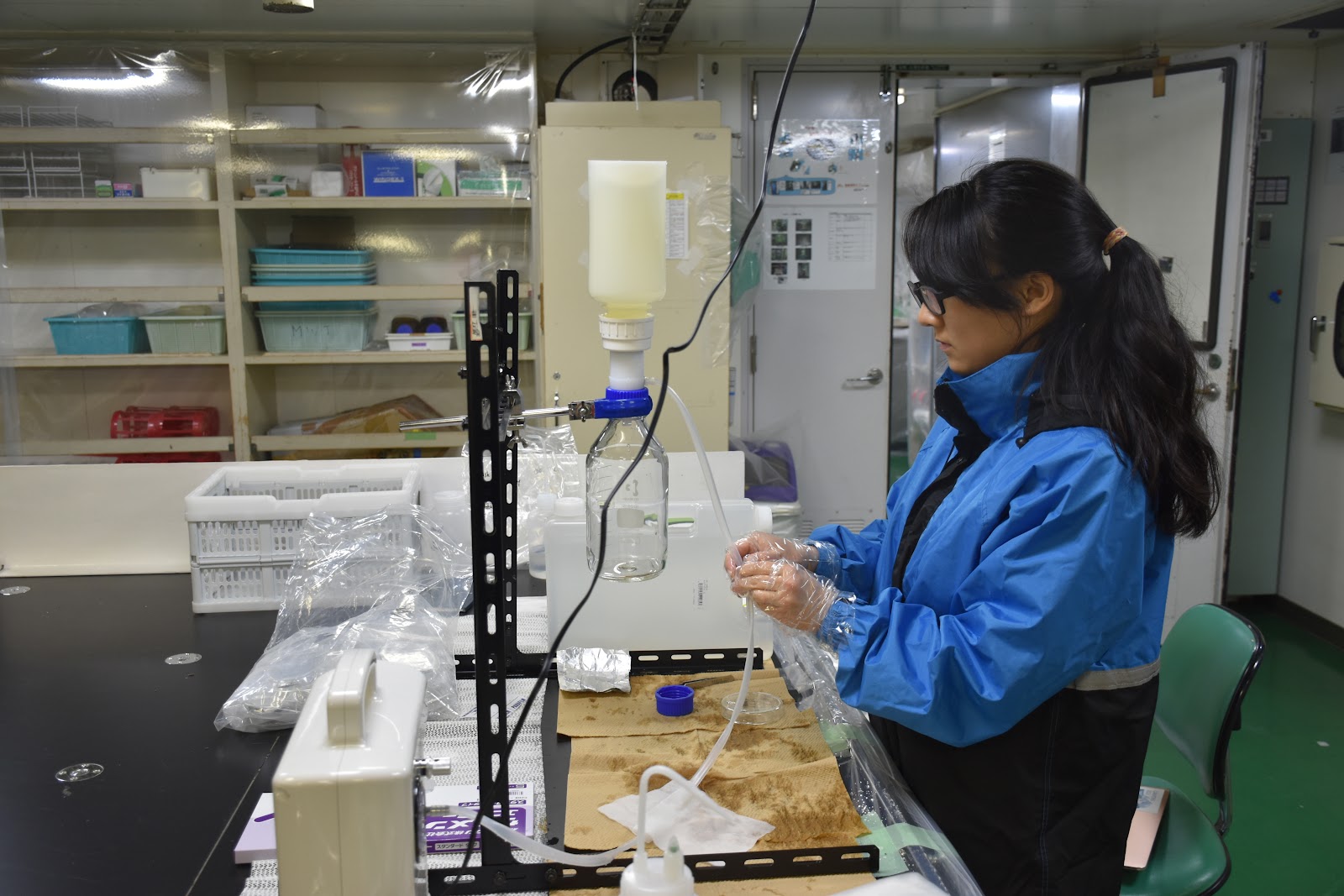
This time I am in charge of water sampling. We only collected pumped up water of surface ocean with no CTD. Surface seawater is pumped into the vessel from the bow and can be collected from a faucet in the laboratory. Water sampling and discharging from the stern is done constantly so that local seawater can be sampled in real time. We sampled samples for dissolved inorganic carbon (DIC) at 72 sites and dissolved organic carbon (DOC) and particulate organic carbon (POC) at 14 sites. 


During my free time, I helped with core splitting. Playing with mud is so much more fun than staying up all night for water sampling! Not that I don't enjoy water sampling at all :p Or maybe, it's because there were so many people helping with sediment core splitting and chatting with them was fun.

Captain’s View & Learning to Lead

Since I was the only person doing water sampling, I had to track the ship’s location, speed, and direction to decide my sampling frequency. That meant I had the privilege of visiting the captain’s room multiple times—easily the best view on the ship.


Most importantly, I grew a lot on this journey. I learned that asking for help isn’t a weakness—it’s a skill. Learning when to take responsibility on myself and when to delegate tasks is a skill I still have to polish. 

Group photo at the beginning of the cruise (when I didn't know anybody on board)


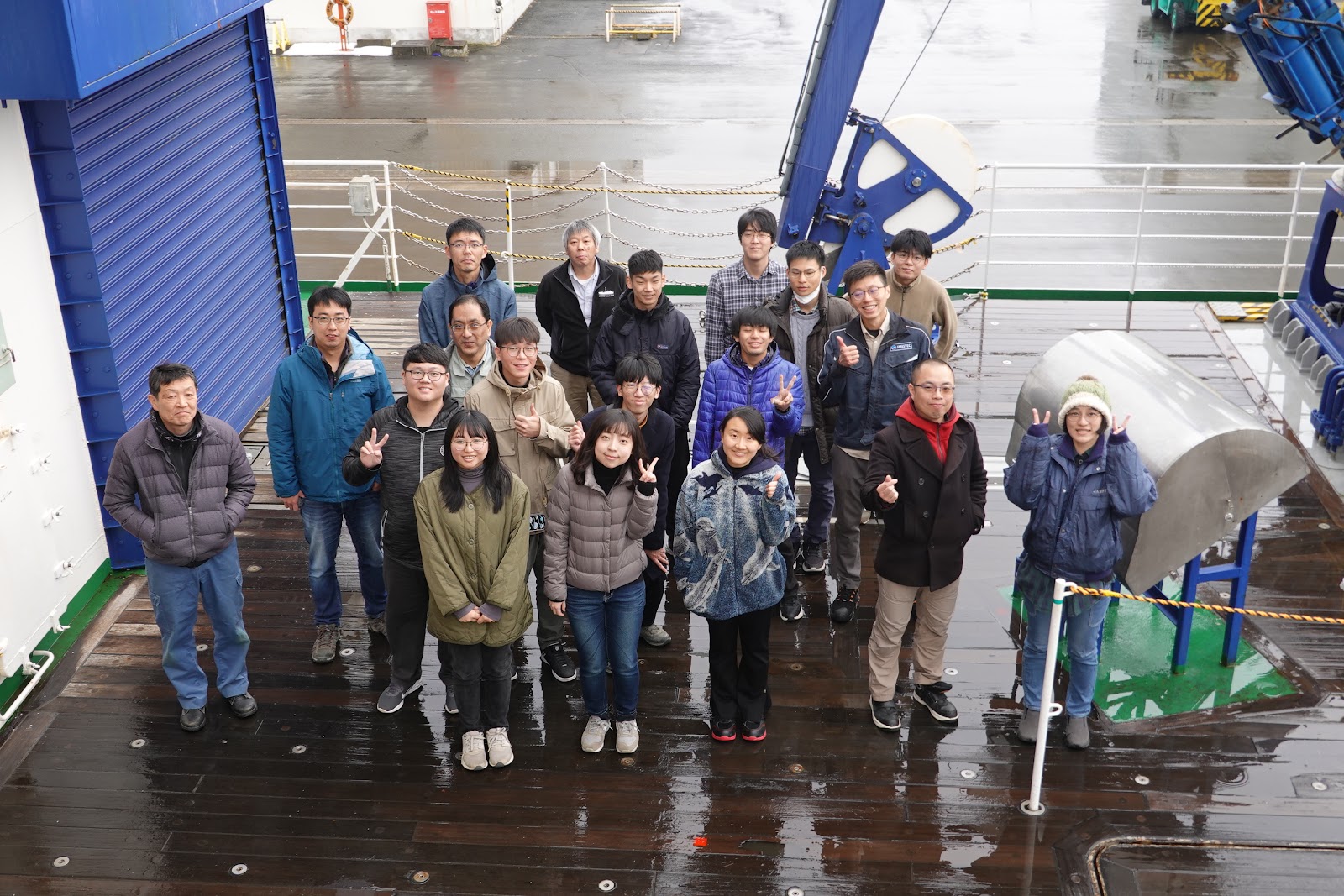
Group photos at the end of the cruise (when I knew almost everyone on board). I was late for the first one where more people were in :p


What’s Next?

I once dreamed of working on Chikyu and even got accepted for a part-time job last year with マリンワーク, but then could not end up going since my residency in Japan caps work at 28 hours/week. Boarding Chikyu also requires helicopter evacuation training, where they drop a full-scale helicopter into a pool, flip it upside down, and make you escape. For several times in various scenarios! Sounds wild, but I still want to try someday.

Despite the struggles, the exhaustion, and questioning my life choices mid-waves, ocean science keeps pulling me back. The adventure, the unknown, and the deep-sea secrets make it all worth it. For now, I’m gearing up for my next cruise—hopefully with a little more sleep, a little more balance, and just as much excitement. I will bring ukulele this time heehee 🌺

Until next time—
Bon voyage! 🚢💙🌊

Jumping again!


P.S. Here are more information if you wish to learn more about this cruise~

If you want to see interesting stories of what happened on board, please check out my Instagram story archive.

If you want to learn more about the science on board, please check out the cruise report.

1/14/2025

New Papers (Nature, etc.) 2024/12/30–2025/1/12

Nature

1. Limitations of ice cores in reconstructing temperature seasonality

T. Laepple, T. Münch, N. Hirsch, F. Shaw  & M. Hörhold


2. Abrupt changes in biomass burning during the last glacial period

Ben Riddell-Young, James Edward Lee, Edward J. Brook, Jochen Schmitt, Hubertus Fischer, Thomas K. Bauska, James A. Menking, René Iseli & Justin Reid Clark


Communications Earth and Environment

3. Near-term benefits from investment in climate adaptation complement long-term economic returns from emissions reduction

Lei Duan, Angelo Carlino & Ken Caldeira


4. A millennium of cold and humid climate decreased carbon accumulation in the subtropical monsoon peatland

Bin Liu, Hanxiang Liu, Ying Wang, Zicheng Yu, Yuwen Fu, Zhengyu Xia, Chengyu Miao & Jia Jia


5. Weakening of subsurface ocean temperature seasonality over the past four decades

Fukai Liu, Yiyong Luo, Fengfei Song, Wen-Xiao Yu, Jian Lu & Lijing Cheng


Nature Communications

6. Seasonal changes of mélange thickness coincide with Greenland calving dynamics

Yue Meng, Ching-Yao Lai, Riley Culberg, Michael G. Shahin, Leigh A. Stearns, Justin C. Burton & Kavinda Nissanka


7. Tipping point-induced abrupt shifts in East Asian hydroclimate since the Last Glacial Maximum

Fuzhi Lu, Huayu Lu, Yao Gu, Pengyu Lin, Zhengyao Lu, Qiong Zhang, Hongyan Zhang, Fan Yang, Xiaoyi Dong, Shuangwen Yi, Deliang Chen, Francesco S. R. Pausata, Maya Ben-Yami & Jennifer V. Mecking


8. Tracing ancient solar cycles with tree rings and radiocarbon in the first millennium BCE

Nicolas Brehm, Charlotte L. Pearson, Marcus Christl, Alex Bayliss, Kurt Nicolussi, Thomas Pichler, David Brown & Lukas Wacker


9. Asynchronicity of deglacial permafrost thawing controlled by millennial-scale climate variability

Xinwei Yan, Xu Zhang, Bo Liu, Huw T. Mithan, John Hellstrom, Sophie Nuber, Russell Drysdale, Junjie Wu, Fangyuan Lin, Ning Zhao, Yuao Zhang, Wengang Kang & Jianbao Liu


10. Global mean sea level likely higher than present during the holocene

Roger C. Creel, Jacqueline Austermann, Robert E. Kopp, Nicole S. Khan, Torsten Albrecht & Jonathan Kingslake


Scientific Reports

11. Assessing the preservation potential of successive hurricane overwash deposits in Florida, USA mangroves

Isabel Hong, Kristen M. Joyse, Jennifer S. Walker, Arielle L. Nogueira, Wynn Bryant, Kara R. Radabaugh & Donald C. Barber 


12. Identification of deposits from modern and ancient large tsunamis by means of environmental DNA

Tetsuya Shinozaki, Akira Iguchi, Miyuki Nishijima, Kazuhisa Goto & Shigehiro Fujino

1/13/2025

New Papers (ELSEVIER) 2024/12/31~2025/1/12


[Chemical Geology]

1. Uranium-series isotopes as tracers of physical and chemical weathering in glacial sediments from Taylor Valley, Antarctica

Graham Harper Edwards, Gavin G. Piccione, Terrence Blackburn, Slawek Tulaczyk


[Geochimica et Cosmochimica Acta]

2. Carbon Cycling in Marine Particles Based on Inorganic and Organic Stable Isotopes

Sijia Dong, Frank J. Pavia, Adam V. Subhas, William R. Gray, Jess F. Adkins,  William M. Berelson


[Global and Planetary Change]

3. Evapotranspiration increase is more sensitive to vegetation greening than to vegetation type conversion in arid and semi-arid regions of China

Yixuan Zhu, Zhoutao Zheng, Guang Zhao, Juntao Zhu, Bo Zhao, Yihan Sun, Jie Gao, Yangjian Zhang

4. New Sea-ice biomarker data from Bering-Chukchi Sea surface sediments and its significance for pan-Arctic proxy-based sea-ice reconstruction

Jiang Yiao Zhang, Xiaotong Xiao, Ruediger Stein, Wenshen Xiao, Rujian Wang, Yang Ding, Lupeng Nie , Meixun Zhao

5. Impact of ENSO on extreme precipitation in Southwest Asia

Omid Alizadeh, Morteza Mousavizadeh

6. Effects of climate change and methane-rich fluid activity on sedimentary sulfur geochemical records in the northern South China Sea since mid-Pleistocene

Junxi Feng, Yufei Zhang, Niu Li, Jianhou Zhou, Jinqiang Liang, Qianyong Liang, Shengxiong Yang, Duofu Chen, Harunur Rashid 

7. Response of atmospheric CO2 changes to the Abyssal Pacific overturning during the last glacial cycle

Yanan Zhang, Gang Li, Jimin Yu, Yi Zhong, Jianghui Du, Xun Gong , Xiaodong Jiang , Congcong Gai, Shiying Li, Qingsong Liu

8. Human settlement and destructive activities disrupt the positive contribution of dust to plant biomass growth over the past 2000 years

Lin Chen, Youliang Huang, Menghan Qiu, Zhilun Li, Rui Yang, Mengjing Li, Huiling Sun, Lixiong Xiang, Shanjia Zhang , Xiaozhong Huang , Aifeng Zhou

9. Possible influence of low latitude wetland area changes on the Holocene global atmospheric methane concentration trend

Yunping Song, Hai Xu, Kevin M. Yeager

10. Stalagmite records of spatiotemporal hydroclimatic variations in monsoonal China during 47–12 ka BP

Miaomiao Wang, Haiwei Zhang, Youwei Li, Rui Zhang, Jian Wang, Hanying Li, Yuteng Zhao, Xiaomei Zhang, Zeyuan Liang, Youfeng Ning, Hai Cheng


[Palaeogeography, Paleoclimatology, Paleoecology]

11. Indian summer monsoon history during the last glacial cycle revealed by a loess sequence from the Tibetan Plateau

Pushuang Li, Shengli Yang, Yuanlong Luo, Li Liu, Yixiao Zhang, Weiming Liu, Jingzhao Zhang, Xuechao Xu, Chen Wen, Qiong Li

12. Characteristics and driving mechanisms of early Holocene weakened monsoon events: Evidence from northern Bohai Bay, China

Hanfei You, Shixiong Yang, Yuecong Li, Shengrui Zhang, Zhen Zhang, Linyuan Ma, Jiheng Shi, Ying Wang, Xiaotian Zhang, Yunfei Yang

13. A dual bivalve approach for interpreting past sea surface temperatures and seasonality from shell midden sites using oxygen isotope sclerochronology

Sarah D. Kuehn, Meghan Burchell, Natasha Leclerc

12/26/2024

The Amami symposium - A little personal report

Hi zusammen, 

this is Ida an exchange student from Germany, currently doing a research internship at AORI.

This is a timy little report about my participation at the Amami symposium held in November this year at Amami Oshima. The symposium brought together scientists and local people and consisted of various speeches, a panel discussion, and a poster presentation. The poster presentation featured 12 scientists and 8 students from a local high school presenting their research.

As this was the first symposium I participated in, it felt like a great setting to gain some initial experiences, meet people in this field of research, and gain insights into research in Japan. Although I’m learning Japanese, my comprehension is still quite basic, and especially in the scientific context, it’s definitely まだまだです. 

Although I experimented with Google Translate, I had some difficulties following the content of the speeches. Depending on the person speaking, and especially on the amount of text on the slides, it was sometimes easier, sometimes harder to follow.  Even though I would always agree that slides shouldn’t contain too much text, in this case I was quite happy about full slides, which I could translate using Google Lens ;) Additionally, I gained some confidence on the second day and was able to talk to some of the speakers after their speeches, to get a mini-English summary and the opportunity to ask some questions, which was a great opportunity.


In the beginning, I was quite intimidated talking to new people due to my lack of experience regarding cultural and social rules in this new setting, my basic level of Japanese and the fact that a lot of people seemed to know each other already. After the first day, a joint dinner, and a little boost in self-confidence, I got to talk to more people on the second day and had the opportunity to also talk to some local people like, for example, a woman working for the local newspaper. I really like the idea of bringing local people and scientists together, and I wished I could have talked even more to people from Amami. 


The poster presentation went well and ended up being quite lively. Preparing the poster in advance already taught me a lot about how to structure and present my own scientific ideas. On the first day, the explanation of the poster was mostly in English, and it felt like a good practice to talk about research with new people. It got better with each time presenting, and I’m grateful that I was able to have the experience in this setting without much pressure. On the second day, we presented our posters again in front of some of the high school students. This again challenged my Japanese skills, but it was a lot of fun, and with a lot of Katakana English Japanese, some help from a very kind English teacher, and some laughs we got there in the end. I think the vocabulary I was missing the most might have been 放射性炭素 (radiocarbon). I can recommend looking up some basic words in advance, but even without, it somehow worked out and we got to laugh a lot.


On both days, we went to a joint dinner together. For me, this was one of the most impressive experiences. The culture of eating out and drinking together after work was already a new experience for me as a non-Japanese student. Especially impressive was getting to hear the
島歌 (island songs) accompanied by traditional local instruments, the 三線 (a three-string instrument), and even being able to try the instruments ourselves. We were highly recommended to learn to play the 三線, as you’re supposed to be able to learn it in only one month. The local food was amazing too, and even being vegetarian there was plenty of different flavorful food to try.

During the symposium, we also got to talk a little bit about the organization and brainstormed on how it might be possible to make the event even a little more diverse in the upcoming years. I really like the idea of holding the symposium in Amami and therefore making it accessible to local people and especially high-school students. I would have been interested to hear even more the perspectives of local people in the speeches (e.g., about topics like: ‘How has climate change affected Amami in the last few years?’ or ‘How to find a balance between tourism and preservation?’). However, I might have also missed parts of that due to the language barrier. I think it is essential as s scientists to learn from local people and focus on incoporating a local and culturaly sensitive perspective. 

I was also wondering how far it might be possible to invite more women as speakers to create a balance between women and men speaking. If possible, I think it would be great to encourage even more young students to participate too, as I think this is a great setting to gain first experience, get some first contacts, and receive feedback on one’s own work. This might change the dynamics a little bit but could make exchange between different groups of people and approaching new people a little easier, as it could mix up the group dynamics a bit. As diversity in (natural) sciences is a topic that I’m also very interested in, I would be very interested to brainstorm together and think of different possible approaches.

At the end this trip also helped me to get to know some new people and grow closer to friends I knew already before. I got the best teachers for revising kanji and explaining Japanese grammar and even found somebody who would run into the ocean together during a warm rainy day. I would like to thank everybody who participated, organized and contributed to this event and who made this experience possible. It was a pleasure to participate, and I’m glad I got the opportunity to have had this experience.